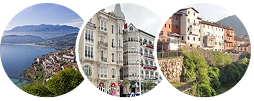

Everything you need to know for 2 or 3 days in Santiago and the Interior
There are so many things to see and do in Santiago de Compostela and the inland provinces of Lugo and Ourense we usually recommend at least 3 nights in the area, 2 stops if you have the time, whether visiting on a short break or as part of a broader northern Spain holiday. Here’s our guide covering all the highlights of inland Galicia…

Santiago - end of an epic journey
Journey´s end for pilgrims since the Early Middle Ages, Santiago de Compostela is also goal for tourists from all over the world who cross the breath of northern Spain. Its amazing cathedral, set on the lovely Obradoiro square, will make you fall in love at first glance, but the city has a lot more to offer. Start or end your north Spain holiday in Santiago, it´s up to you, but don´t miss it!
Emerald hills
As with any north Spain holiday the mountains are never far away. Head in from the coast and you’ll discover a landscape of rolling emerald hills and unspoilt mountain ranges. Predominantly rural the interior has its own gastronomic delights such as Spain’s best beef, potatoes, delicious bread and, surprisingly, the finest octopus in north Spain!
Fiesta time
Watch out for the fiestas – there’s always something going on and here you’ll find some real treasures where ancient traditions are still maintained.
Take the waters
The interior too is defined by water with over 20 spa baths and the stunning Rio Sil where you can enjoy a catamaran trip through the vertiginous vineyards of the Ribera Sacra.
Or the wine...
On the steep banks of the Sil and Miño rivers, between the famous Rias Baixas to the west and Ribeira Sacra to the east, you will find the best Ribeiro wines - Galicia's fresh and fruity whites of great quality. Drink from the bowl!
TABLE OF CONTENTS
6 THINGS TO SEE AND DO IN SANTIAGO AND THE INTERIOR
OTHER POINTS OF INTEREST IN INLAND GALICIA
LOCAL FESTIVITIES AND TRADITIONS IN SANTIAGO & THE INTERIOR
Things to see and do in Santiago and the Interior
Santiago de Compostela
Campus Stellae - Field of the Stars
Santiago de Compostela, for centuries Europe’s most important pilgrim destination, is a ‘must-see’ for visitors to Galicia and northern Spain. Dotted with charming palaces, impressive churches and monasteries, a walk through its historic quarter, one of the most elegant in Spain, will help you discover the legends and best-kept treasures of a remarkable city.
The colossal cathedral dedicated to St James with its famous swinging “Botafumeiro” marks the end of the pilgrimage route and, even if you are not religious at all, visiting it is an experience shouldn´t miss. Likewise, it´s very emotional to watch the pilgrims enter the Praza do Obradoiro after their epic journey.
A major University city, Santiago is lively by day or by night, with lots of authentic bars in which to sample the lovely white wines of Ribeiro or Albariño and the local speciality, octopus – a la Gallega of course!
Ribeira Sacra
The Sacred Land of Wine and Monasteries
The Ribeira Sacra, an area shared by the provinces of Lugo and Ourense, refers to shelters for monks and hermits in the dramatic gorges of the Rivers Sil and Miño from Suevian times. Numerous monasteries, hermitages and abbies were founded there from the 6th century onwards and although the monks who cultivated vineyards on the banks of the rivers, abandoned the monasteries in 1835, expelled by Mendizabal, the impressive buildings still stand in beautiful settings.
From San Pedro de Rocas with a church dug into the rock to the best preserved San Estevo de Ribas de Sil, a trip around these monasteries and the area is a fascinating experience.
Lugo
A Roman-built city with intact walls
The fine old city of Lugo, the capital of the province of the same name, in Galicia, has long been a detour for pilgrims on their way to Santiago de Compostela and boasts the best ancient walls in Spain, wonderful slate walls enclosing the old town, magnifcently preserved from Roman times. A sight to be seen with 85 rounded towers and four gateways. Added to this is its amazing Cathedral, originally built in 1177, modelled on the cathedral of Santiago with the rare privilege of manifestado (always having the host on display).
There are picturesque squares and streets with other important civil and religious buildings, but one of Lugo’s other fames is food. The Galician’s having a saying which literally means to eat, go to Lugo. It is great for traditional Galician food, particularly pulpo - octopus - and the tapas bars on Calle Cruz and Rúa Nova are full of atmosphere in the early evening.
During the first fortnight in October Lugo celebrates the Festival of San Froilán which originally represented a period of preparation for the coming of winter. There are all sorts of culinary delights and street stalls selling traditional Galician products and bubbling copper cauldrons of octopus, combining an exceptional meeting point between the urban and rural worlds.
Ourense
Amazing hot springs and best octopus ever!
The provincial capital of Ourense on the banks of the impressive River Miño, named by the Romans from the word oro - gold - because of its ancient gold mines and for its amazing unusual steaming hot springs - Las Burgas, is a city of surprises. You can take a relaxing soak in one of the springs - temperatures reach around 70ºC, wander around its old quarter with its patchwork of little squares and porticoed streets, visit its fine cathedral and its Santisimo Cristo (the crucifix has real hair and beard), admire the Roman Puente Viejo, one of the longest bridges in Spain, and if hunger strikes in Ourense sample some of the best octopus in Galicia washed down with the excellent wines from Ribera Sacra.
Rio Sil
Sculptor of canyons and terraced vineyards
Take a Catamaran trip down the magnificent Rio Sil, a tributary of the Rio Miño, in the Ribeira Sacra region of Galicia, passing through the provinces of Lugo and Ourense and you will be in for a real treat. Enjoy the spectacular landscape as the river winds through the canyon and you will be amazed by the steep slopes where vineyards of the famous Ribeira Sacra wine grow.
Combine the catamaran trip with a visit to two of the many monasteries in the Ribeira Sacra region - the remarkable San Esteban de Ribas de Sil founded in the 10th century and the little jewel of Santa Cristina de Ribas de Sil, a tiny monastery in Romanesque style in the midst of a natural paradise with an impressive view onto the Rio Sil canyon.
Los Ancares
A hidden gem treasured by León and Galicia
It is hard to find a more unique and different, yet little discovered area than Los Ancares, situated on the border of León and Galicia. So rich in flora and fauna these dramatic mountains with their indigenous forests and amazing vegetation, delightful valleys watered by clear rivers and streams and dotted with vegetable patches have been inhabited for over two thousand years.
Typical Celtic dwellings - round stone thatched buildings called pallozas, medieval castles, pre-Romanesque churches and pre-Roman castros add to the scene. Walking through this area takes you into a distant world, far from modern worries - the breathtaking views and the sound of silence will stay with you for a long time.
Other Points of Interest in Inland Galicia
Betanzos
The capital of the Galician Gothic
Originally a Celtic village which grew into a Roman port, and was thriving in the 18th century. The Praza de Garcia Hermanos with its 18th century buildings, the historical Museo de las Mariñas (Weekdays 17:00-20:00 and Saturdays 11:00-13:00), the three churches of the square - 14th century Santa de Maria de Azogue, 15th century Santiago and Gothic San Francisco - are some of its main attractions.
Ribadavia
Land of the best Ribeiro wines
Lovely old town with the best preserved Jewish quarter in Galicia. It has a magical cake shop making cakes from recipes of long ago in the beautiful Praza Mayor, interesting churches and the Wine Museum “Museo de Ribeiro” (10:00-13:00 and 17:00-20:00). 5kms away is the “Monumento de Beade” with 3 granite crosses looking out across vineyards and horreos.
Pazo de Oca
The “Versailles of Galicia”
Pazo de Oca, southwest of Santiago, near A Estrada, and open from 9:00 to dusk. Dubbed the “Versailles of Galicia” though on a much smaller scale, the gardens were landscaped in the 18th century withlakes, a bridge, garden ornaments, vine arbours and a church. Now owned by the Duchess of Alba, whose ancestor was painted by Goya.
Monforte de Lemos
Capital of Ribera Sacra´s wine region
The elegant town of Monforte serves as the main centre for the Ribera Sacra wine region and has several good eateries on the main street. The town is dominated by the castle on the hill, now a Parador, but once home to the Counts of Lemos, and the oversized Jesuit monastery Colegio de la Compañía down in the town.
Allariz
A Historic-Artistic Site on the banks of the Arnoia
Allariz, south of Ourense, is a delightful medieval town (a monument in itself) where the film “La Lengua de las Mariposas” (Butterfly’s Tongue) was filmed. Declared a Historic-Artistic Site, it sits on the banks of the Arnoia river, offering picturesque sights.
Monasterio de Santa Maria la Real de Oseira
The Galician Escorial
Of the many wonderful monasteries in the Ribera Sacra (literally ‘Holy River’) region of Galicia this is perhaps the most famous. Known as the Escorial de Galicia for its immense size and renaissance architectural style, the monastery was a favourite stopping place of Graham Greene and features in his book Monsignor Quixote (an excellent holiday read). Don’t miss the Churringuesque façade and the stunning Sala Capitular or ‘Palm Tree Room’.
Playa A Cova - fluvial beach
If you’re weighing up the pros and cons of interior vs beach holiday look no further. The Ribera Sacra has several beaches and no end of wonderful swimming spots. Playa A Cova (set just below the top-class winery of Abadia da Cova – what more could you want) is as good a beach as you’ll find at any seaside resort and has water-sports and a nice ‘chiringuito’ restaurant.
Castro de Viladonga
Celtic heritage in inland Galicia
As with monasteries, there are so many Castros (Celtic settlements) in Galicia that it’s hard to know which to choose.
One of the more impressive examples is Castro de Viladonga near the town of Castro do Rei, north-east of Lugo.
Not only is it one of the best-kept examples, but the fortified setting is quite amazing, and there’s a good museum on site to help make sense of it all.
Local Festivities and Traditions in Santiago & the Interior
Local festas where not otherwise specifed (please check dates)
Santiago - Fiestas de Santiago
Last fortnight of July (centred around the day of St James on the 25th) - two weeks of festivities. 25th July National Holiday for the day of St James - Dia de Santiago Apostol -, patron saint of Spain. Huge celebration in Santiago. Big fireworks on the night of the 24th July in Plaza Obradoiro - next to the Cathedral.
Festival do Vino da Ribera Sacra
It celebrates the local Ribera Sacra wines. Best wineries of the area. It takes place every year on the banks of the River Cabe in Monforte de Lemos.
Carnaval de Verin
One of the most ancestral carnivals in Galicia. The "fariñadas" (flour battles) and the figure of the "Cigarron" are its characteristic elements. It has been declared of Tourist Interest.
Feira do Cocido de Lalin
The cocido is a typical dish from the town of Lalín. The Festival is held on the Sunday before Carnival in Lalín. In 1999 it was declared of Tourist Interest.
Carnaval de Laza
It is one of the most ancient and traditional carnivals in the world. The central figure is the Peliqueiro. Declared of Tourist Interest.
Ribeiro Wine Festival of Ribadavia
First weekend of May. Presentation of the wines of the season. It has been declared of Tourist Interest.
Os Maios - Ourense
It takes place on the first weekend of May. It consists of vegetal constructions in the form of a pyramid or wooden cone and burlap covered with moss, flowers and finished off with a cross representing the genius of vegetation, which is reborn in spring.
Ourense - Pulpo and more pulpo!
All over Galicia, but particularly in Ourense and in the surrounding towns you will often see a pulpo ”stand” set up in the street, usually with a few tables and chairs or beside a bar. This is where the locals go to buy their pulpo, freshly cooked before your eyes along with boiled potatoes and bread – “pulpo a feira”. They either eat it there on the spot or take it home.
Frequently Asked Questions about Things to See and Do in Santiago and the Interior
Getting there
Inland Galicia is best enjoyed by flying directly to Santiago de Compostela airport. It is the nearest to the area, but you could alternatively fly into A Coruña or Vigo.
The best options are:
- Stansted: Santiago with Ryanair
- London Gatwick: Santiago and A Coruña with B.A. or Vueling
- London Heathrow: Santiago with Vueling
- Dublin: Santiago with Aer Lingus
*Check our tour pages for more up-to-date details.
PLEASE NOTE Flights are not included and some flights are seasonal.
If you wish to bring your own car, classic car or motorbike, we can include the ferry crossings as part of the package – see timetables below:
Getting around
A car is essential for getting around and to make the most out of the visit as many of the hotels and attractions are not easily accessed by public transport.
If travelling by air we usually include a hire car whilst those coming on the ferry will use their own vehicle. In either case we will provide full driving instructions, GPS co-ords for the accommodation and essential information on driving in Spain and Portugal as well as a touring map of the area.