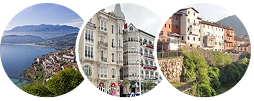

Everything you need to know for 2 or 3 days in Salamanca
In south-west Castilla y Leon, on the border with Portugal, Salamanca Province is best known for its capital of the same name, one of Spain's most beautiful cities and home to one of the country's oldest and most important universities. The Old Town, a World Heritage Site, is truly monumental, a real showcase for Spanish Renaissance architecture, and at its heart the enormous Plaza Mayor is surely one of the finest anywhere.
Head west, toward the border with Portugal, and discover the walled city of Ciudad Rodrigo, also steeped in history. Or head north to Zamora, the city with the most Romanesque churches in all of Europe!

The Sierra de Francia
For a change of scale and pace, explore the medieval villages of the Sierra de Francia, with their churches, squares, and narrow streets opening to give spectacular views.
La Alberca is the best known, but all the mountain villages are worth exploring. Rural traditions are very much alive; fiestas crowd the local calendar, and the old crafts-in leather, basketwork, and pottery-are still practised.
To the south, above the high plains, rises the Sierra de Francia, with the Peña de Francia (at 1,723 m) as its highest peak. Mountains and river valleys, sleepy villages, lost in time, pure fresh air, and country living-a perfect getaway.
Terraced valleys with orchards of cherry, peach, and almond, groves of olive trees, vineyards, forests of chestnut and oak, and higher up, wild lavender, heather, and fern.
The clear mountain air helps to cure the region's famous jamón serrano (try the local Gijuelo-one of Spain's finest hams) and ‘embutidos’ (cured sausages), as well as helping to promote an appetite!
TABLE OF CONTENTS
Salamanca Highlights
City of Salamanca
Where History Glows at Sunset
Worthy of a section to itself Salamanca city is has so much to see and do. It is known as "the golden city" due to the beautiful golden color that acquire their buildings in the light of sunset. Sunrise and sunset are magical moments.
The light manages to transform both the interior of the buildings and their exterior, a singular light that bathes the gilt-coloured façades.
Also known as "the city of thought", this is the university city par excellence: Salamanca University was the first to be founded in Spain and besides being one of the oldest in Europe, it is also one of the country's best examples of Renaissance architecture. Its old town was declared a World Heritage Site by UNESCO in 1988 and is home to a magnificent ensemble of monuments, with outstanding examples of different architectural styles: Romanesque, Gothic, Baroque, Plateresque...
Its stunning Main Square is considered to be the most beautiful one in Spain and can even be compared with those in Europe. Salamanca is always ready to welcome newcomers and to proudly show off the richness of its cultural heritage, its culture and its gastronomy.
It´s a young and cosmopolitan city, with a multitude of hidden corners and historic buildings, all located within the historic centre so the best way to discover it is on foot.
Salamanca´s University
The factory of thought
Founded in 1218, is the first university of Spain and the second oldest European university in continuous operations. It is wedged between the Plaza Mayor area and the Tormes River. It has represented and still represents a vital organ of the city, the "factory" of thought. By 1254 it had received acknowledgment from Pope Alexander IV as being one of the four great world universities, along with the universities of Oxford, Paris and Bologna.
The golden, sandstone façade is considered to be the ultimate expression of Plateresque architecture. Hidden within this sculpted tapestry is one of Salamanca's secrets: the ever-elusive frog. If you are able to find it (without somebody pointing it out to you), you're guaranteed good luck and marriage!
Upstairs, the highlight is without a doubt the Salamanca University library. Boasting thousands of antique books arranged on wooden shelves and huge globes of the world, it will certainly give you an idea of the unrivalled academic splendor of the Salamanca University during the Renaissance. Just nearby don’t miss the Patio de las Escuelas.
The Cathedrals of Salamanca
From Romanesque Roots to Baroque Heights
Salamanca boasts two cathedrals. The old one, a truly magnificent Romanesque monument, stands side by side to the new one which was built in varying styles ranging from Gothic to late Baroque.
The Old Cathedral is dedicated to Santa Maria de la Sede and is one of the ultimate expressions of Romanesque style in Europe, topped off by the Torre del Gallo – its world-famed dome. The Cathedral also has a cloister and several chapels where students spent the night awake before an important exam.
The wall paintings in the Chapel of St. Martin are very well preserved. The New Cathedral, built in the 16th century and completed in the 18th century, houses the image of the Virgin of the Assumption. It is an excellent example of monumentality that contrasts dramatically with the sober simplicity of the nearby Romanesque cathedral. There are impressive pillars and an imposing Baroque dome rising above the transept to reach a height of 80 metres. The choir, one of the most important of Spanish Baroque, was built by Alberto Churriguera.
Don’t forget to gaze at the decoration of the massive doors, you'll find an astronaut and an ice cream cone - belonging to the last restoration - amongst the otherwise Renaissance and Baroque adornment. Well worthwhile is the Jeronimus exhibition which includes a visit to the towers and a rooftop walk.
Main Square
The Heartbeat of the Historic Centre
The Main Square of Salamanca is the political centre of the city, the social centre and the main meeting point. Known as the city's "living room", it is a great starting point and introduction to discover the nearby treasures.
It is considered to be the most beautiful square in Spain, no easy feat considering that almost every city and town has one.
It has been used for several purposes such as autos-da-fe, executions of the Spanish Inquisition and even bullfights. Nowadays it is filled with terrace cafés where you can sit, relax and gaze at the marvellous architecture.
Conventos de San Esteban y Las Dueñas
You can visit both convents just east of the Cathedral. San Esteban has a truly magnificent Plateresque façade which must be seen at sunset, when the red stone seems to be on fire. Over the road, Las Dueñas has a lovely cloister with views of the Cathedral.
Puente Romano, Rio Tormes
History Reflected in a Quiet River
Just south of the Old Town, the Puente Romano over the Río Tormes dates to Roman times. The river has wide parklands on either side, which locals and students use like a beach in the warmer months - great for a break from the city or to get a bit of exercise.
Art Nouveau and Art Deco Museum (Casa Lis)
A Journey Through Art Nouveau Splendour
The Casa Lis is an impressive building created in 1905 by architect Joaquín Vargas Aguirre for Miguel Lis, an enthusiast of the Art Nouveau style. It is one of the city’s most admired monuments, and its north façade - now the main entrance - is considered the finest example of modernist architecture in Salamanca.
Although originally built as a private residence, since 1995 the Casa Lis has been home to the Museum of Art Nouveau and Art Deco, showcasing an extensive collection of pieces from these two closely related artistic movements.
La Casa de las Conchas
Salamanca’s Most Enigmatic Façade
The Casa de las Conchas is a historic building constructed at the end of the 16th century by Rodrigo Arias de Maldonado, a knight of the Order of Santiago de Compostela.
Its distinctive façade is decorated with more than 300 shells - the symbol of the Order of Santiago - combining Gothic and Plateresque styles. The entrance door, featuring a Gothic coat of arms, and the dolphins on the architrave - a Renaissance symbol of love - are also worth noting.
Today, it houses Salamanca’s public library and an information office.
Huerto de Calixto y Melibea
A Hidden Oasis with a Timeless Tale
Situated directly upon Salamanca's ancient walls with views of the Tormes River and of the Cathedral towers, the Huerto de Calixto y Melibea is considered to be the prettiest of Salamanca's parks.
The quiet, intimate garden full of leafy trees and flowers was intentionally built to be a romantic parcel of land for leisurely strolls. The gardens' medieval aspect and romantic air are only intensified by its literary reference, named after the characters Calixto and Melibea from Fernando Rojas' masterpiece "La Celestina."
Other Special Places
Ciudad Rodrigo
A Walled Jewel on the Frontier
Ciudad Rodrigo, the most important village of Salamanca, is a famous fortified town situated in the west of the province. Its walls enclose a rich heritage of civic and religious buildings, standing out the beautiful Cathedral in Romanesque and Gothic style and the Castle of Enrique II de Trastámara, which nowadays is a parador.
It sits on top of a rocky hill on the banks of the river Águeda, and the wall surrounding this small town reflects its strategic importance in the past. Occupied by Neolithic settlers, Vettones, Romans, Moors and finally Christians, it was repopulated in 1100 by Count Rodrigo González Girón, from whom it took its definitive name.
Its historic quarter, which is a Historic-Artistic Site, dates back to the 15th and 16th centuries, a period during which the city enjoyed its golden age. Stroll around its sleepy streets and you will feel the echo of history at every step.
Regarding culture, one of the most popular fiestas among the inhabitants of Ciudad Rodrigo is the so-called Carnaval del Toro (bull carnival). As its name suggests, bulls play a major role in this celebration. Farinato (a type of sausage made with breadcrumbs, pork fat, paprika and other spices) is the most typical of the local delicacies and is best served with fried eggs. Other local dishes worthy of mention are chanfaina (based on rice and pork), hornazo (a type of pie) and roasts, especially suckling pig.
Sierra de Francia
Scenic Routes Through Storybook Villages
La Peña de Francia gives its name to the mountain range of which (at 1723m) it is the highest peak. Watered by the Francia and Alagón rivers and by natural springs and pools, the sierra is littered with little ancient villages, secluded for centuries, which look over terraced valleys with orchards of cherry, peach and almond, groves of olive trees, vineyards, forests of chestnut and oak, and higher on the Sierra wild lavender, heather and fern. Summer days are hot but escape the scorching temperatures of the plains, and the nights are always pleasantly cool, while in spring and autumn blue skies come with a freshness in the air.
La Alberca
Stone Houses, Wooden Balconies, Eternal Beauty
The nerve centre of the Sierra de Francia and its best known village, with houses in the typical mountain style, La Alberca was the first rural village in Spain to be given National Historic Heritage status.
As you go deep into its streets you will notice a curious play of light and shadows created by the protruding upper floors and roofs of the houses. It has been said that the urban structure of La Alberca is a Jewish quarter due to its intricate, labyrinthine and secret streets.
The main square, surrounded on all four sides by columned porches, continues to be the centre of the town's social life and it is a good place to buy ham and other local souvenirs. Its celebration of the Assumption of the Virgin is considered to be the best in Spain.
Miranda del Castañar
A Fortress Village Steeped in History
A favourite of ours and less touristy than La Alberca, this walled village - declared Property of Cultural Interest is located in the heart of the Sierra de Francia Mountains.
Wander through the streets and you will travel back to a time when Jews and Moors inhabited the village. As well as noble buildings bearing coats of arms and traditional houses, made up of masonry and wood (typical of the mountains in Salamanca), the town has other interesting monuments. Starting by the old walls that surround it and the four gates that lead to the historic quarter and define the urban layout: San Ginés, La Villa, Nuestra Señora and El Postigo.
The castle, built in the 15th century, and its surroundings are especially interesting, as well as the Plaza de Armas. Other places worth mentioning are the Campanas Tower, built in the 17th century, in the church square; and the corn exchange building, the current Town Hall, built in 1585. Miranda del Castañar also preserves two of its five shrines: Humilladero, and outside the walls, Virgen de la Cuesta.
Ledesma
A Village That Whispers Centuries of History
The beautiful town of Ledesma is only 35 kilometres from the city of Salamanca, on the banks of the Tormes River, close to the Arribes del Duero Nature Reserve. It's worth going for a walk to discover Prehistoric monuments such as the "verraco" (animal figure), the menhir or the remains of the Roman walls.
The town also boasts important monuments such as large houses, palaces, churches, the castle and the Gothic Church of Santa María la Mayor. Follow the waymarked routes starting at the History Visitor Centre. The Urban Route will take you to one of the most important parts of the old quarter, whilst the Mocho Bridge Route crosses an ancient holm oak forest where you might spot griffon vultures and black kites.
The bridge is Roman in origin and was declared a Property of Cultural Interest. For the town's gastronomy, don't miss its famous doughnuts, which are made in traditional workshops that can be visited. And finally, if you want to come to one of the town's festivities, we recommend the Corpus and the famous running of the bulls.
San Felices de los Gallegos
Medieval Walls and Timeless Views
This is one of the fortified defence points lying between the Spanish and Portuguese border and a fine example of defensive architecture set amidst stunning natural scenery. Its old quarter has the Property of Cultural Interest designation.
The enclosure of mediaeval origins is protected by the castle and the walls. The wall, built of stone blocks with adjoining square towers, dates from the 13th century and encircles a spacious bailey. Inside the walls, it is worth noting the parish church (12th-13th centuries) in the transitional Romanesque style (façade and bell tower) modified in the Gothic-Renaissance period.
Highlights of its civil architecture are buildings such as the Town Hall (16th century), the Alhóndiga and various noble mansions with their carved coats of arms.
Calendario
Rural Heritage and Scenic Beauty
This is the village of fountains, with a church dedicated to water. Candelario is one of the most beautiful villages of the mountain range with its tilting roof edges, balconies and unique doors named batipuertas – a two-leaf door – whose bottom leaf was used as protection against snow and water.
The murmur of the currents coming down from the snowfields in the form of water paths is a pleasure to one's ears. The beautiful popular architecture is adapted both to the outline of a steep orography and to the rebel climatology in winter.
Don’t miss the exquisite cured meats of the local gastronomy!
San Martin del Castañar
A Picturesque Village in the Sierra de Francia
Another beautiful village of the mountainous region with a lot of interesting corners. The town crowds around the 13th century church, though it stands on the site of a former Roman settlement. Its main attractions are the castle - its own graveyard included – and the bullring, according to some sources the second oldest in Spain.
Other notable places are the river and its surroundings, the square and the fountains or "pilones." In the bakery - the only one in the village - you can taste the "perronillas" (handmade, assorted pastries), different varieties of muffins and "hornazos" (a type of Spanish filled pastry).
Mogarraz
A Living Canvas of Castilian Heritage
One of the most typical villages, Mogarraz has been converted into an open-air art gallery with portraits of the locals adorning the streets.
On the road there’s the Mirasierra restaurant, one of the best in the region, which has its own winery, and two good charcuteries.
Villanueva del Conde
Medieval spirit in mountain landscapes
The village of the Three Lies (not Villa, not Nueva, and not of the Conde), another typical village with some very pretty corners and lovely views.
Guijuelo cured ham
The Art of Spanish Curing, Perfected
Guijuelo is a town situated on the Iberian plain over 1,000 metres above sea level. It is bordered on the east by the Tormes River, on the west by Mt. Tonda, and on the south by two mountain ranges: Sierra de Béjar and Sierra de Gredos.
Its particular microclimate, characterised by cold, dry winters and short, mild summers, is ideal for the perfect drying and excellent ageing of hams. The pigs, free-range animals of advanced age (18 months), feed on grass and acorns and receive the classification of Acorn Iberian.
The first stage is curing, which lasts six months and is required for proper preservation. Then comes ageing, when the hams and shoulders undergo changes in taste and aroma. Under the watchful eye of master ham processors, the result is a delightful product and unequalled cured ham, internationally renowned for its quality.
Along with La Armuña lentils and Morucha beef, it is one of the greatest gastronomical delicacies of this province in Castile-Leon.
Salamanca's wines
Sip the Spirit of Salamanca
In the Sierra de Salamanca, vineyard and wine have always been linked to nature and human beings. For centuries they have cultivated it in terraced vineyards, seeking integration with the landscape and selecting the best soils and orientations to produce different wines.
The origins of vineyards in this area date back to Roman times. Historical references from the 15th and 16th centuries allow us to attest that the Sierra de Salamanca was known for its excellent wines. Later on, during the 19th century, the vineyard of this land spread, becoming one of the economic pillars of the region. D.O. Sierra de Salamanca and D.O. Arribes are the Protected Designations of Origin of the province.
They are not as renowned as the Rioja wines but, beyond a doubt, their quality is more than guaranteed.
Las Batuecas Nature Reserve
Mystical Landscapes Amid Castilian Mountains
According to the dictionary of the Real Academia de la Lengua, to "be in Las Batuecas" is to be distracted by something, to be absorbed and fascinated.
Feelings of this kind are still felt today by the people who visit this secret valley, a place of incomparable scenic value. The flat surfaces of the plains stand in harsh contrast to deep canyons carved out by the rivers. Its distinct and contrasting vegetation includes everything from Mediterranean farm crops, somewhat infrequent at this latitude, and other ecosystems with a more Atlantic influence such as Pyrenean oak forests.
It is a haven for protected species such as the lynx, wolf, and mountain goat; the royal eagle, vulture, and the black stork. The numerous caverns with Neolithic art to be seen along the way are evidence of ancient civilisation in the area.
Deep in the valley is the Carmelite convent of San José. The convent entrance is the starting point of another trail on foot which takes us to the Cascada del Chorro (waterfall) and also enables us to enjoy the scenic beauty of Las Batuecas.
Frequently Asked Questions about Things to See and Do in Salamanca
Getting there
To / from Madrid
- Gatwick & Edinburgh with Easyjet
- Heathrow with Iberia-BA
- Stansted, Manchester & Birmingham with Ryanair
- Dublin with Aer Lingus
To airports in the North
- Stansted: Santander with Ryanair / Bilbao with Easyjet
- Gatwick: Bilbao with Vueling-BA
- Bristol: Bilbao with Easyjet
- Dublin: Santander with Ryanair / Bilbao with Aer Lingus
- Manchester: Bilbao with Easyjet
- Edinburgh; Santander with Ryanair / Bilbao with Easyjet
Flights are not included
Should you prefer to come by ferry, we can adapt the itinerary to suit. We can include ferry travel at advantageous rates.
Getting around
As part of your package we will include a hire car. Normally we include a 4 door economy class car but please let us know if you would like something different.